


Customization & Integration
"Even with Abridge's Epic plug-in... they reported a 90% adoption rate. Conversely, a solo physician using Freed without integration ended up copying and pasting notes, found little time savings and cancelled after three months." - Real clinic outcomes
Welcome to Part 4 of this 10-part series analyzing AI scribe adoption in clinical practice. If you missed Part 3, "Whose Voice Is It Anyway? Why Style and Reasoning Still Matter", you can find it here.
Today we dive into the factors that truly determine AI scribe success: customization capabilities and EHR integration depth. You can have the most accurate AI in the world, but if it doesn't fit your workflow, it will gather dust.
This reality just became even more critical with Epic's watershed moment in August 2025: the launch of their native AI scribe "Art" and OpenEvidence's simultaneous entry into the scribe market.
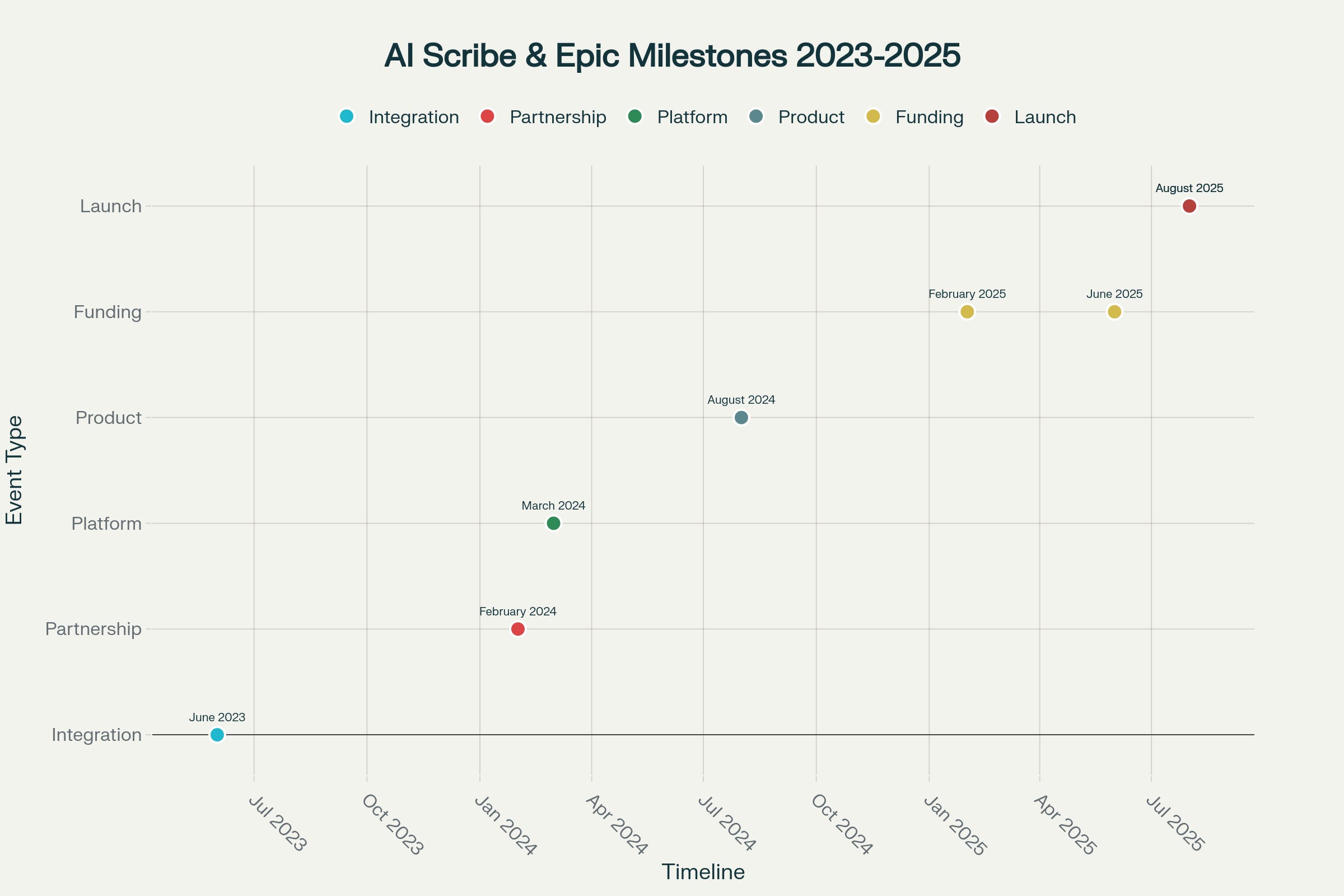
AI Scribe Market Evolution Timeline - accelerating integration developments and Epic's entry reshaping the competitive landscape
The Epic Game-Changer That's Reshaping Everything
When clinics ask me about AI scribes, my first question isn't "Which is best?" It's "How do you document now?"
Epic's entry represents what CIOs are calling a "watershed moment". At roughly $80 per provider per month, Epic undercuts most competitors by 60-80% while providing seamless native integration. When the EHR giant controlling 43% of the U.S. hospital market launches its own ambient scribe, it fundamentally shifts competition from feature parity to workflow depth.
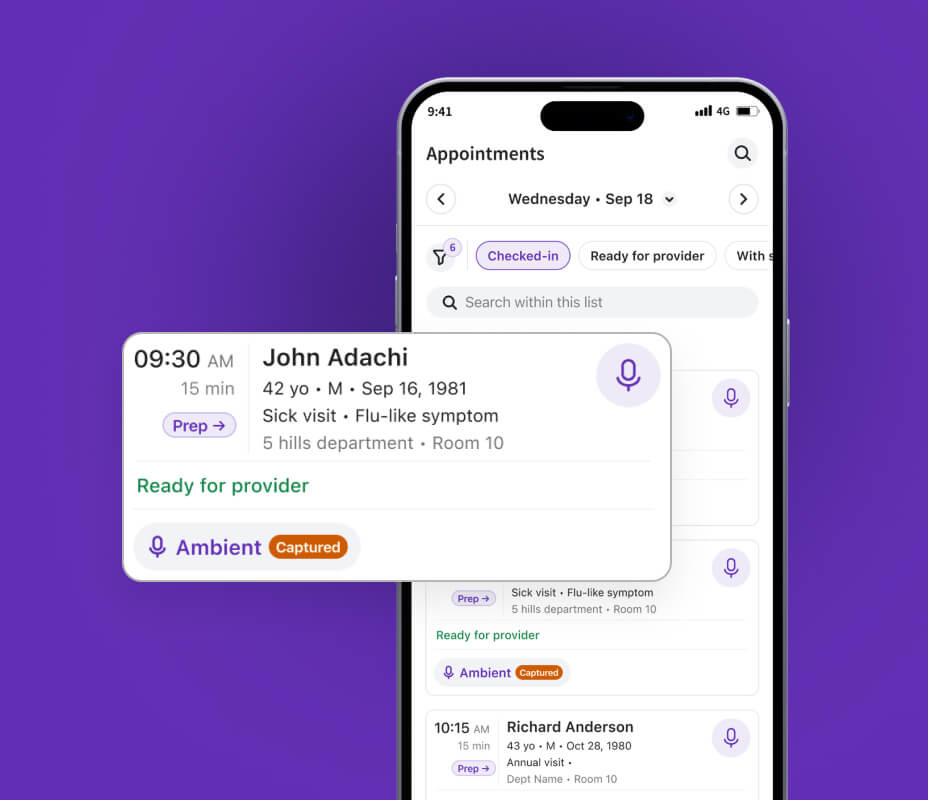
Screenshot of Epic EHR's ambient listening AI feature capturing patient appointment notes in a medical scheduling app
The Art AI assistant uses ambient generative AI to create patient summaries, share diagnostic insights, and leverage Epic's Cosmos platform. More importantly, it works directly within Epic's Haiku mobile app and Hyperdrive desktop interface, eliminating the integration headaches that have plagued third-party solutions.
But Epic isn't alone. OpenEvidence, used by 40% of U.S. physicians, just launched their own AI scribe feature in August 2025, bringing evidence-based clinical guidelines directly into documentation.
OpenEvidence: When Clinical Guidelines Meet Documentation
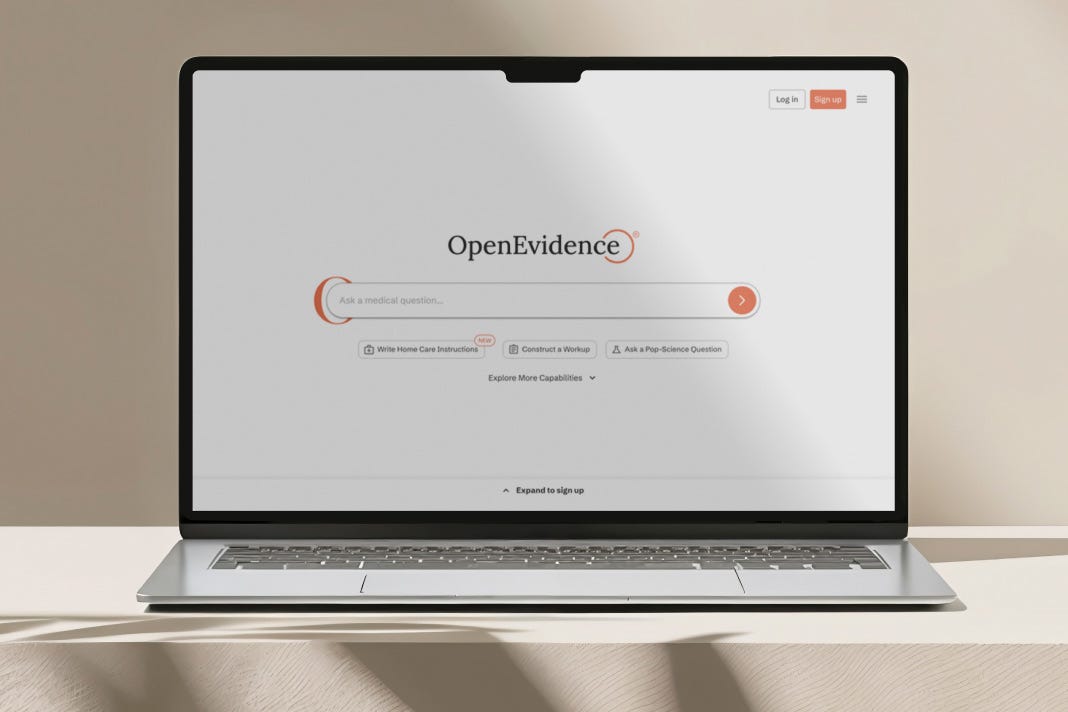
Homepage of OpenEvidence AI platform showing a search bar for medical questions and key features like home care instructions and workup construction
OpenEvidence's approach integrates partnerships with over 10 scientific journals, including JAMA and the New England Journal of Medicine, baking clinical guidelines directly into notes. Their AI achieved the first perfect 100% score on the USMLE and draws from 35 million medical publications.
At a $3 billion valuation, they're betting that evidence-based documentation will differentiate them. However, early feedback suggests physicians may care more about revenue cycle workflows than having notes cite the latest research.
Why Customisation Limitations Still Kill Adoption
Despite these market-shaking developments, the fundamental challenges haven't changed. On r/Psychiatry, a user praised Nabla for generating a good HPI but criticized its custom-instruction support as "not very robust," preventing the addition of templates. They wanted to insert a template and have the AI fill it out but couldn't.
Another comment in r/FamilyMedicine praised Heidi's terse language but noted the website is heavy and "a touch slow" on tablets.
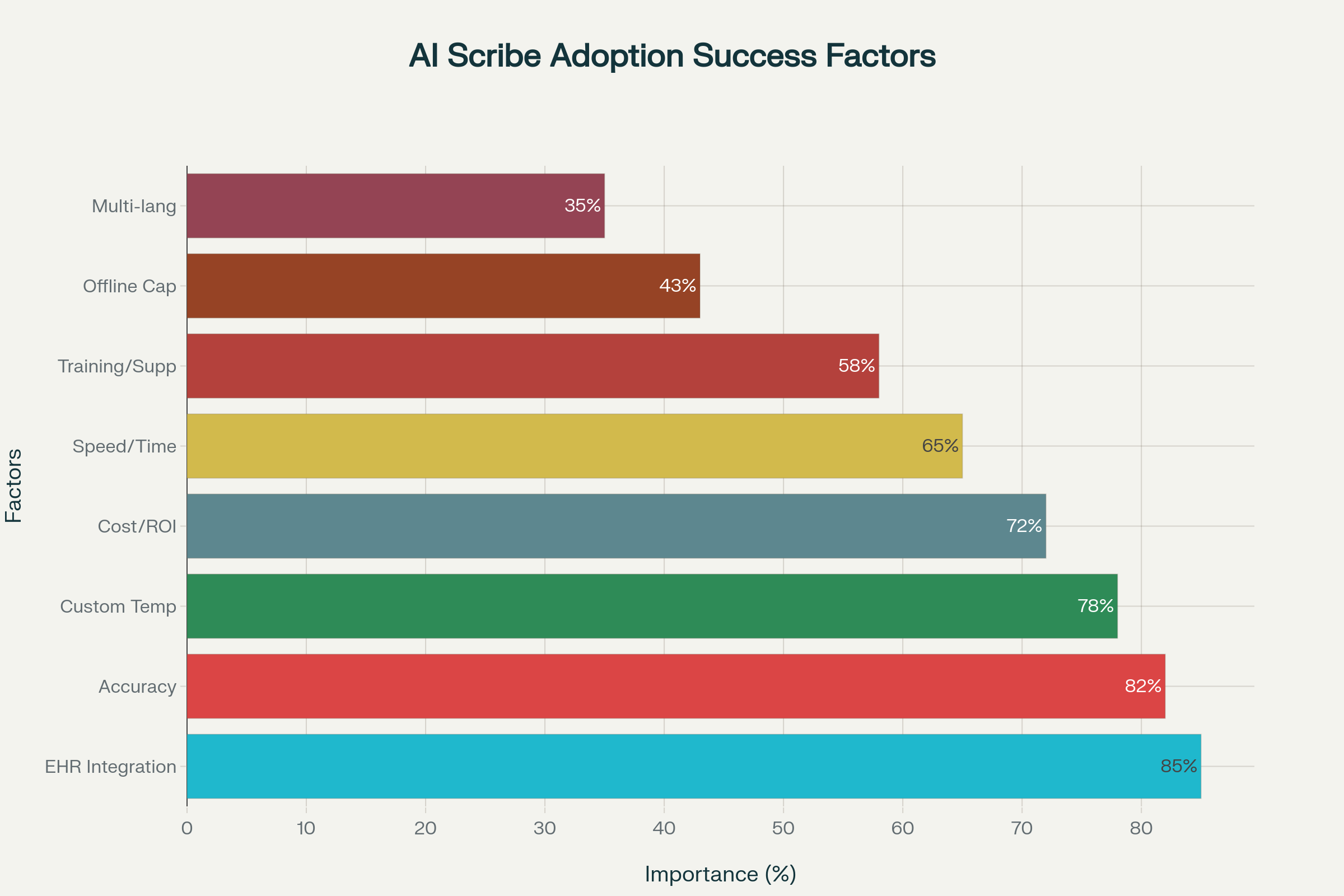
Factors Driving AI Scribe Adoption Success - EHR integration and customization capabilities rank as top priorities for healthcare organizations
Why do these limitations matter? Because clinicians rely on dot phrases, macros and templates to ensure consistency. Without them, you end up re-editing AI notes, negating time savings. Recent research shows EHR integration ranks as the top factor (85%) in AI scribe adoption success, followed closely by custom template support (78%).
Current Vendor Landscape: Integration vs. Features
Vendors vary widely in customization and integration:
Epic AI Scribe (Art): Native integration, $80/month, powered by Microsoft Dragon technology
TwoFold: Known for customizable templates and quick drafts but lacks direct Epic/Cerner plugins. Users must copy and paste.
Freed: Offers minimal features but quick turnaround at $99/month. Some like the simplicity; others dislike the lack of customization.
Heidi: Highly customizable with low hallucination rates, but the website can be slow.
Nabla: Easy to sign up, good at HPI generation, poor at custom instructions.
Abridge: The current market leader with 95.3% KLAS rating and deployment across over 150 health systems. Their "Abridge Inside" allows deep Epic integration without leaving the EHR.
Integration Headaches: When Copy-Paste Kills ROI
A comment on the s10.ai article noted that TwoFold lacks direct Epic or Cerner plugins, forcing users to copy and paste. Another user of Abridge said the integration with Epic saved time by avoiding copy-paste. Without integration, any time saved on note generation gets lost transferring data.
From my work at Teché Consulting, integration often determines ROI. In a rural Quebec clinic using a legacy EMR, we spent more time exporting and importing AI notes than we saved in charting. Only after building a custom API hook did the solution pay off. That's why our AIMatchbox tool rates scribes based on EHR compatibility.
Recent studies validate this. Abridge users with deep Epic integration report 78% improved work satisfaction and 53% increased undivided attention with patients. Conversely, a study from Intermountain Health found workflow friction dampened benefits even with good technology.
The Microsoft-Epic Partnership: Redefining Integration Standards
Epic's collaboration with Microsoft creates a unique value proposition. Microsoft's $19.7 billion acquisition of Nuance brought enterprise-grade ambient technology now powering Epic's solution. Peter Durlach from Microsoft notes Nuance DAX Copilot shows 85-90% physician dependence with 50% reduction in documentation time.
This enables Epic to offer multimodal AI capabilities, processing video, voice, images, and genomic data, all within unified workflows that don't require switching applications.
Canada-Specific Compliance: The Integration Multiplier
For Canadian practices, integration complexity multiplies with PIPEDA and provincial privacy requirements. Most Canadian EMRs don't enable direct AI scribe integration, forcing copy-paste workflows.
Canadian-compliant solutions like Scribeberry store data exclusively on Canadian servers with AES-256 encryption, but often lack the deep EHR integration available in the U.S. market. Canada Health Infoway's AI Scribe Program provides up to 10,000 fully funded one-year licenses, but availability varies by province.
Questions to Ask Vendors Before You Sign
Before you sign a contract, get answers to these:
Integration Depth: Does your tool integrate with my EHR via FHIR/HL7, or am I stuck with copy-paste? Recent standards from Epic expand ambient voice recognition options, but implementation varies.
Customization Granularity: Can I build or upload my own templates? How granular is customization? Look for SMART on FHIR app capabilities.
Offline Capability: Is there an offline mode? Free tiers often lack offline capture. In regions with poor connectivity, this matters.
Data Security: What happens to data during integration? For Canadian practices, ensure data sovereignty with Canadian server hosting.
Clinical Decision Support: Does the AI provide evidence-based recommendations like OpenEvidence, or just transcription?
My Field Notes: What Actually Works
I've seen practices succeed when they assign a tech-savvy champion to liaise with vendors. That person tests integration in a sandbox, builds macros and trains staff. Without this internal champion, even well-integrated tools flounder.
One multi-site clinic used Abridge's Epic plug-in. The integration let providers launch the AI scribe directly within Haiku/Canto and get notes in under five minutes. They reported 90% adoption rates.
Conversely, a solo physician using Freed without integration ended up copying and pasting notes, found little time savings and cancelled after three months.
At Teché Consulting, we implement a verification workflow that adds integration checkpoints. Yes, it adds a minute or two, but saves far more in rework and compliance issues.
Market Dynamics: The Funding Frenzy Meets Reality
The AI scribe market is experiencing explosive growth. Investment doubled from $390 million in 2023 to $800 million in 2024, with Abridge alone raising $550 million across two rounds in 2025.
But growth comes with consolidation pressure. Epic's $80/month pricing creates significant downward pressure on competitors charging $300-700 monthly. As one VC noted: "It'll underperform to start, and they'll slowly improve it and erode existing players' market share."
Looking Ahead: Don't Wait for Perfect Integration
Integration will improve as vendors mature. But don't wait. If your chosen scribe lacks a plug-in, explore middleware solutions like Mirth Connect, RPA bots or custom FHIR scripts. It's work, but the payoff can be significant, practices report ROI exceeding 12,000% when factoring in all benefits.
The Epic entry changes the game, but doesn't eliminate thoughtful vendor selection based on your specific workflow, EHR system, and integration capabilities. The vendors that survive will solve real integration problems, not just transcription accuracy.
Coming Up
In Part 5, we'll examine speed and reliability, because even perfectly integrated AI is useless if it isn't there when you need it. We'll look at real-world performance data and what "fast enough" actually means in clinical practice.
Which EHR do you use, and how well does your AI scribe integrate?
With Epic's launch shaking up pricing and integration standards, are you reconsidering your current solution?
Uzziel Tamon
Helping Clinics Run Leaner & Smarter | Clinical Operations Consultant | EMR, AI Tools & Custom Workflows
https://techehealthservices.com/